
 By vakkas
The term PMO can be surprisingly confusing — especially when you see it online. One moment, it’s a snappy slang used in a text or TikTok comment; the next, it’s a serious acronym in corporate boardrooms. So, what does PMO really mean?
In slang, PMO often stands for “Piss Me Off” — a quick way to express irritation or frustration. But in business, PMO means something completely different: the Project Management Office, a key department that drives organization and strategy.
This article dives deep into both worlds — exploring how PMO works as modern internet slang and how it functions as a business concept. You’ll see examples, real-world uses, and even tables comparing meanings. Whether you’re decoding a text message or preparing for a job interview, this guide will help you understand every shade of PMO meaning.
When you come across “PMO” in messages or comments, it rarely has anything to do with corporate life. Online, PMO = “Piss Me Off” — a phrase that expresses mild annoyance or irritation. It’s similar to saying “That annoys me” or “You’re making me mad,” but more casual and direct.
For example:
- “You PMO when you don’t text back 😤”
- “That ad PMO fr, it’s everywhere.”
The slang meaning usually appears in informal digital conversations — on TikTok, Instagram DMs, or Snapchat streaks — where short, emotional expressions dominate.
However, PMO can shift in tone depending on the situation. Sometimes it’s lighthearted teasing; other times, it’s genuine frustration. It’s all about the vibe and emojis used alongside it. Saying “U PMO 😭” feels playful, while “You PMO.” (with a period) might sound serious or angry.
Interestingly, this abbreviation’s popularity reflects how Gen Z and Millennials shorten almost anything for quick communication — especially feelings. “PMO” packs emotion into just three letters, making it perfect for fast chats.
When used in texting, PMO behaves like a mini emotional marker — expressing feelings without spelling them out. Let’s break down a few examples to see how context changes meaning:
| Example Text | Implied Meaning | Tone |
| “Bruh, that teacher PMO fr 💀” | The person is frustrated but joking. | Casual/Funny |
| “You really PMO sometimes.” | Mild irritation, possibly serious. | Neutral/Annoyed |
| “Stop calling me that 😭 PMO rn.” | Emotional, used humorously. | Playful/Relatable |
The abbreviation blends naturally with slang like “fr” (for real), “icant,” or “rn” (right now). Together, these short forms create fast, expressive sentences that feel authentic in chats.
People also use PMO in group messages when venting or reacting to something unexpected. For instance:
- “My phone just died mid-call. PMO 💀”
- “I missed the sale again, PMO 😭.”
Notice how the tone isn’t aggressive — it’s more about sharing an emotion with friends. Unlike full curses, PMO softens the expression, making it safer to use in semi-public spaces like social media comments or online forums.
Social platforms like TikTok, Snapchat, and Instagram have turned abbreviations like PMO into everyday language. On TikTok, you might see comments such as “When he leaves you on read again 😭 PMO” under relatable skits. The meaning is instantly clear to anyone fluent in internet slang: something or someone is irritating you — usually in a funny, exaggerated way.
TikTok users often pair PMO with reaction videos or trending audios. It’s part of “relatable rage” humor — where frustration is shared for laughs. Hashtags like #PMO, #youPMO, or #PMOfr appear in captions describing small annoyances like slow Wi-Fi or clingy exes.
On Snapchat, PMO pops up in quick snaps or private streaks. Because conversations are short-lived, abbreviations like PMO help express emotion fast. A picture of a broken coffee cup captioned “PMO 😤” says it all — no long text needed.
Instagram users tend to use PMO in stories or comment threads. You might see it under memes or reels:
- “Every Monday morning 😩 PMO fr.”
- “When Spotify ads hit mid-vibe 😭 PMO.”
Across these platforms, PMO becomes more about connection than conflict. It helps people express shared frustration in a humorous way, making them feel understood and seen.
When in doubt, internet users often turn to Urban Dictionary, the go-to resource for slang decoding. According to the site, PMO primarily stands for “Piss Me Off” but has multiple variants and related forms depending on tone and context.
Here are the most common ones you’ll see online:
| Slang Variant | Full Form / Meaning | Context Example |
| PMO | Piss Me Off | “These bugs PMO every night.” |
| ICL PMO | I Can’t Lie, Piss Me Off | “ICL PMO when people chew loud 😭.” |
| TS PMO | That Stuff Piss Me Off | “TS PMO when ppl ignore calls.” |
| PMO rn | Piss Me Off Right Now | “My Wi-Fi PMO rn 😤.” |
| You PMO fr | You Piss Me Off for Real | “You PMO fr, bro 😭.” |
Each variant adds flavor — using extra words to amplify emotion. “ICL PMO” sounds dramatic but funny, while “PMO rn” feels more urgent and real-time.
Urban Dictionary entries also note that PMO isn’t inherently rude; it depends on tone and intent. In friendly circles, it’s like saying “You’re annoying me, but I still like you.” But when used flatly, it can cross into serious territory.
In short, PMO as slang has evolved from pure anger to a mix of humor, frustration, and digital personality. Its flexibility keeps it relevant across generations of internet users.
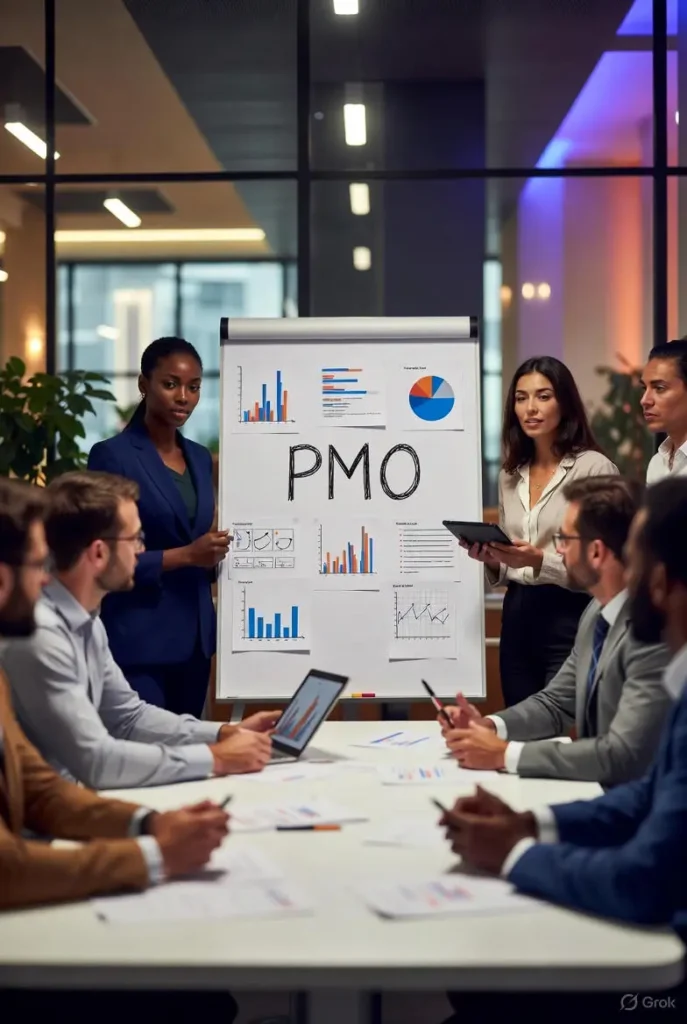
After exploring PMO’s lively slang side, it’s time to switch gears to the professional world — where PMO means something entirely different.
In corporate settings, PMO stands for Project Management Office — a strategic department or team that defines, maintains, and ensures project management standards across an organization.
While the slang PMO deals with emotions, the business PMO deals with execution, consistency, and success. Every project-driven company — from startups to global enterprises — relies on its PMO to turn plans into results.
Think of the Project Management Office as the central command center of all projects. It tracks progress, optimizes resources, ensures deadlines are met, and aligns projects with overall business goals. Without a PMO, projects can drift off track, duplicate efforts, or burn through budgets.
In short, when someone in business says “Our PMO is implementing new standards,” they’re not angry — they’re talking about the backbone of project governance.
A Project Management Office (PMO) is an internal group responsible for developing project management frameworks, methodologies, and best practices. Its purpose is to create structure and visibility across projects so organizations can deliver efficiently and predictably.
- Standardization – Create consistent processes and templates for project execution.
- Governance – Ensure every project complies with organizational policies and quality standards.
- Support – Provide tools, coaching, and mentorship to project managers.
- Performance Tracking – Monitor KPIs, budgets, and deliverables to ensure accountability.
- Strategic Alignment – Connect project outcomes with long-term company goals.
Here’s a quick summary table showing PMO objectives and outcomes:
| Objective | Description | Expected Outcome |
| Standardization | Build consistent templates & reporting structures. | Fewer delays, better predictability. |
| Governance | Enforce compliance with policies & risk controls. | Stronger quality assurance. |
| Support | Offer guidance, training, and tool access. | More capable project teams. |
| Performance Tracking | Measure KPIs, budgets, and timelines. | Improved accountability. |
| Strategic Alignment | Align project goals with company vision. | Higher ROI and strategic clarity. |
A mature PMO serves as both a coach and a controller — guiding teams while ensuring discipline. The best ones find the right balance between flexibility and structure.
Not all PMOs look alike. Their structure depends on the company’s culture, maturity, and scale. Generally, there are three main types of PMOs — each with different levels of authority and involvement.
A Supportive PMO provides templates, training, and guidance but doesn’t directly control projects. It’s best for organizations with experienced project managers who value autonomy.
- Role: Consultant and helper.
- Function: Offers documentation, templates, lessons learned.
- Advantage: High flexibility; fosters innovation.
- Challenge: Limited influence on compliance.
A Controlling PMO goes beyond support — it enforces policies, standards, and reporting requirements.
- Role: Monitor and evaluator.
- Function: Reviews progress reports, ensures risk management, validates project data.
- Advantage: Better governance and visibility.
- Challenge: Can feel bureaucratic if not balanced.
A Directive PMO takes full control of project management across departments. It assigns project managers and directs how every project runs.
- Role: Central decision-maker.
- Function: Directs project planning, budgeting, and execution.
- Advantage: Strong consistency and alignment.
- Challenge: May reduce team autonomy.
| PMO Type | Authority Level | Best For | Key Benefit |
| Supportive | Low | Mature teams | Knowledge sharing |
| Controlling | Medium | Mid-level maturity orgs | Balanced governance |
| Directive | High | Large or regulated firms | Strategic consistency |
- Portfolio Management: Prioritizing projects based on strategic value.
- Resource Allocation: Ensuring right people and tools are available.
- Risk & Issue Management: Identifying threats early and planning responses.
- Performance Reporting: Creating dashboards for stakeholders.
- Continuous Improvement: Capturing lessons learned for future projects.
A well-run PMO acts like a navigator — constantly aligning the organization’s project efforts with its business map.
Running a PMO without the right tools is like sailing without a compass. Modern PMOs rely heavily on digital platforms that support collaboration, visibility, and performance tracking.
| Tool Name | Primary Function | Best For |
| Jira | Agile project tracking, sprint boards | Software development teams |
| Asana | Task management and team collaboration | Marketing & creative teams |
| Microsoft Project | Detailed scheduling, resource allocation | Traditional project planning |
| Monday.com | Visual workflows & dashboards | Cross-functional project tracking |
| Smartsheet | Spreadsheet-based project control | Enterprises managing multiple projects |
These tools help PMOs maintain transparency, automate reports, and detect bottlenecks early.
To establish credibility, PMO professionals often pursue global certifications such as:
- PMP (Project Management Professional) – validates advanced project leadership skills.
- PRINCE2 (Projects in Controlled Environments) – emphasizes governance and process.
- CAPM (Certified Associate in Project Management) – for newcomers learning PM basics.
- PMI-PBA – focuses on business analysis and alignment.
These credentials strengthen a PMO’s knowledge base and ensure standardized methodologies across teams.
- IBM’s Enterprise PMO – coordinates thousands of global IT projects through standardized frameworks and AI dashboards.
- NASA’s PMO – monitors cost, schedule, and risk metrics across multiple space missions.
- Unilever’s Global PMO – aligns sustainability projects with corporate strategy worldwide.
Such examples show how PMOs can scale from small operations to complex, multinational environments while maintaining control and clarity.
Even the best PMOs face challenges. Establishing structure in dynamic, fast-changing organizations can be difficult. Yet, the value they bring often outweighs the obstacles.
| Challenge | Description | Impact if Ignored |
| Lack of Executive Support | Senior leaders don’t champion PMO efforts. | Low adoption, limited authority. |
| Resistance to Change | Teams prefer their own methods. | Fragmented processes. |
| Unclear KPIs | Success metrics aren’t defined. | Hard to prove ROI. |
| Over-bureaucracy | Too many forms and approvals. | Reduced agility. |
| Technology Gaps | Outdated tools or no integration. | Data inaccuracy and delays. |
To overcome these, PMOs must position themselves as value enablers, not just rule enforcers.
Organizations justify PMO investments through measurable returns. These typically include:
- Higher project success rate – projects finish on time and on budget.
- Improved resource utilization – better workload distribution.
- Enhanced visibility – executives see progress in real time.
- Cost reduction – fewer overruns and rework.
A mature PMO can boost project performance by up to 30%, according to industry research. The ROI often becomes visible within the first two years when practices mature and teams adapt.
One of the most common confusions in business discussions is between PMO and Project Manager (PM). Though both relate to project management, their roles differ significantly.
| Aspect | PMO (Project Management Office) | Project Manager (PM) |
| Definition | Department that sets standards, policies, and governance for all projects. | Individual responsible for executing a specific project. |
| Scope | Organization-wide. | Project-specific. |
| Responsibility | Oversight, reporting, resource allocation, methodology design. | Planning, executing, and closing a project. |
| Focus | Strategy and process. | Delivery and outcomes. |
| Authority | Advisory or directive across teams. | Direct control over assigned project only. |
In simple terms, the PMO designs the “how,” and the Project Manager executes the “what.” The two roles complement each other: PMOs provide structure and guidance; PMs deliver results within that framework.
When the relationship is healthy, projects flow smoothly, communication stays clear, and overall business performance improves.
The business world is changing faster than ever — and so is the Project Management Office.
As organizations adopt Agile, AI, and digital transformation, PMOs are evolving from control-centric units to strategic partners that drive innovation and adaptability. The future PMO is less about enforcing rules and more about enabling outcomes.
Let’s look at the biggest trends shaping tomorrow’s PMO.
Traditional PMOs once focused heavily on rigid structures, templates, and documentation. But the rise of Agile methodologies like Scrum and Kanban has forced a rethink.
Now, many organizations are moving toward Hybrid PMOs — blending the discipline of traditional governance with the flexibility of Agile delivery.
Hybrid PMO Characteristics:
- Combines waterfall planning with Agile execution.
- Supports both iterative software projects and fixed-scope initiatives.
- Encourages adaptive metrics over static reporting.
- Promotes collaboration between developers, analysts, and executives.
| Approach | Focus | PMO Role in 2025+ |
| Waterfall | Planning → Execution → Closure | Governance and standardization |
| Agile | Continuous delivery, feedback loops | Coaching and support |
| Hybrid | Balance of both worlds | Strategic alignment and flexibility |
Hybrid PMOs are now seen as innovation hubs — empowering teams to experiment while ensuring accountability remains intact.
Artificial Intelligence is transforming how PMOs operate.
By integrating AI tools, PMOs can automate tedious tasks such as data collection, schedule forecasting, and risk prediction.
Examples of AI Applications in PMO:
- Predictive Analytics: AI analyzes project history to forecast delays or cost overruns.
- Natural Language Processing: Chatbots summarize reports or answer team queries.
- Automated Dashboards: Real-time project health monitoring through smart visualization.
Imagine a PMO that knows a project is likely to miss its milestone weeks before it happens — that’s the power of AI.
Companies like Microsoft and IBM already use AI-driven PMO dashboards that adjust risk scores daily, helping leaders make proactive decisions instead of reactive fixes.
Future PMOs are becoming data engines.
Instead of relying solely on qualitative reports, they leverage analytics to prioritize investments and measure value delivery.
Key performance indicators (KPIs) are evolving from simple “on-time/on-budget” metrics to more outcome-focused ones such as customer satisfaction, strategic impact, and innovation rate.
Modern PMO Metrics May Include:
| Metric | Description | Business Impact |
| Value Delivery Index | Measures benefits realized vs. expected. | Quantifies ROI. |
| Stakeholder Engagement Score | Tracks satisfaction and participation. | Improves collaboration. |
| Agility Index | Evaluates responsiveness to change. | Boosts adaptability. |
| Predictive Risk Score | Anticipates delays or failures early. | Prevents crises. |
By linking every data point to strategic outcomes, tomorrow’s PMOs will earn a reputation not as bureaucrats, but as decision-intelligence centers.
Remote work is now standard. PMOs must operate across time zones, cultures, and digital tools.
The rise of Virtual PMOs (VPMOs) allows organizations to manage projects seamlessly without physical offices.
Teams collaborate through platforms like Microsoft Teams, Slack, ClickUp, and Notion, while cloud-based PM software keeps everyone aligned.
Benefits of Virtual PMOs:
- Lower operational costs
- Broader talent pool (global hiring)
- Faster communication through cloud systems
- Easier scalability for growing organizations
Challenges include maintaining team cohesion and data security — but robust digital governance frameworks are helping address these risks.
The PMO of the future won’t just “run projects”; it will shape strategy.
Executives increasingly expect PMOs to act as business partners who translate vision into measurable results. This means participating in budget planning, portfolio prioritization, and digital-transformation leadership.
Emerging focus areas:
- Benefits Realization Management (BRM): measuring what value projects deliver.
- Enterprise Agility: making change management part of everyday culture.
- Sustainability and ESG Integration: aligning projects with environmental and social goals.
- Change Leadership: guiding people through organizational transformation.
Future PMOs will look less like administrative offices and more like strategic performance hubs — helping companies stay competitive in fast-moving markets.
Despite automation, humans remain the heart of every project.
Modern PMOs are increasingly emphasizing people skills, emotional intelligence, and culture-building.
Instead of only tracking metrics, they focus on motivation, communication, and psychological safety — key factors that define project success.
Human-Centric Practices Include:
- Providing wellness and flexibility programs for project teams.
- Coaching project managers on empathy and conflict resolution.
- Recognizing achievements and celebrating small wins.
- Encouraging continuous learning and upskilling.
This shift makes the PMO a trusted ally rather than a compliance watchdog — fostering engagement and productivity.
Another growing concept is the Community PMO, a lighter model that connects project professionals across departments without imposing strict hierarchy.
These PMOs act as knowledge networks, sharing best practices, templates, and mentorship programs.
The goal is collaboration over control — creating a learning ecosystem rather than a reporting chain.
This model works especially well for fast-scaling startups or creative industries where flexibility and peer exchange drive innovation.
Future PMO leaders need more than project credentials. They must combine technical mastery with strategic influence and digital fluency.
Key Skills for Next-Gen PMO Leads:
- Strategic thinking and business acumen
- AI and data analytics literacy
- Change management and communication skills
- Cross-cultural leadership
- Agile coaching capabilities
The modern PMO leader resembles a business architect — someone who designs not just project plans but entire organizational ecosystems.
| Era | Focus Area | Tools & Methods | PMO Identity |
| 1990 – 2005 | Process control and documentation | MS Project, Gantt Charts | Compliance office |
| 2006 – 2015 | Governance and standardization | PMBOK, PRINCE2 | Center of excellence |
| 2016 – 2022 | Digital integration & agility | Jira, Asana, Scrum | Strategic partner |
| 2023 – Present | AI, hybrid models, virtual teams | AI dashboards, hybrid PM | Value enabler / innovation hub |
The trend is clear: PMOs are moving from command-and-control toward enable-and-empower.
In the near future, success will depend less on paperwork and more on insight, innovation, and influence.
It’s fascinating how three identical letters — P M O — can live in such different worlds.
One belongs to the informal rhythm of social media, and the other to the structured flow of corporate strategy. Yet, both share something deeper: expression and impact.
- In slang, PMO expresses emotion — “You piss me off.”
- In business, PMO expresses execution — “We manage and deliver effectively.”
In both contexts, PMO is about reaction and response. Whether it’s an annoyed teenager replying to a text or a project office responding to market change, the essence is the same: a call for control over chaos.
| Context | Meaning | Tone | Purpose |
| Slang (Online Chat) | Piss Me Off | Emotional / Casual | Express frustration or humor |
| Business (Corporate) | Project Management Office | Formal / Professional | Ensure project success and strategy |
Language evolves through people and purpose — and PMO perfectly captures that dual evolution.
So, what’s the full PMO meaning?
It’s a versatile acronym with two very different identities:
- Slang PMO – a quick digital expression for “Piss Me Off,” used humorously or seriously in texting and social media.
- Business PMO – a vital organizational unit, the Project Management Office, ensuring projects align with strategy, deliver value, and maintain control.
In slang, PMO connects people through emotion. In business, PMO connects projects through structure.
Both forms showcase how modern communication — whether digital shorthand or corporate language — keeps adapting to human needs for clarity, speed, and connection.
As technology, culture, and business converge, PMO will continue to evolve.
Whether it’s trending on TikTok or steering billion-dollar portfolios, PMO reminds us that a few letters can carry powerful meaning — from the casual frustrations of daily life to the disciplined precision of global enterprise.